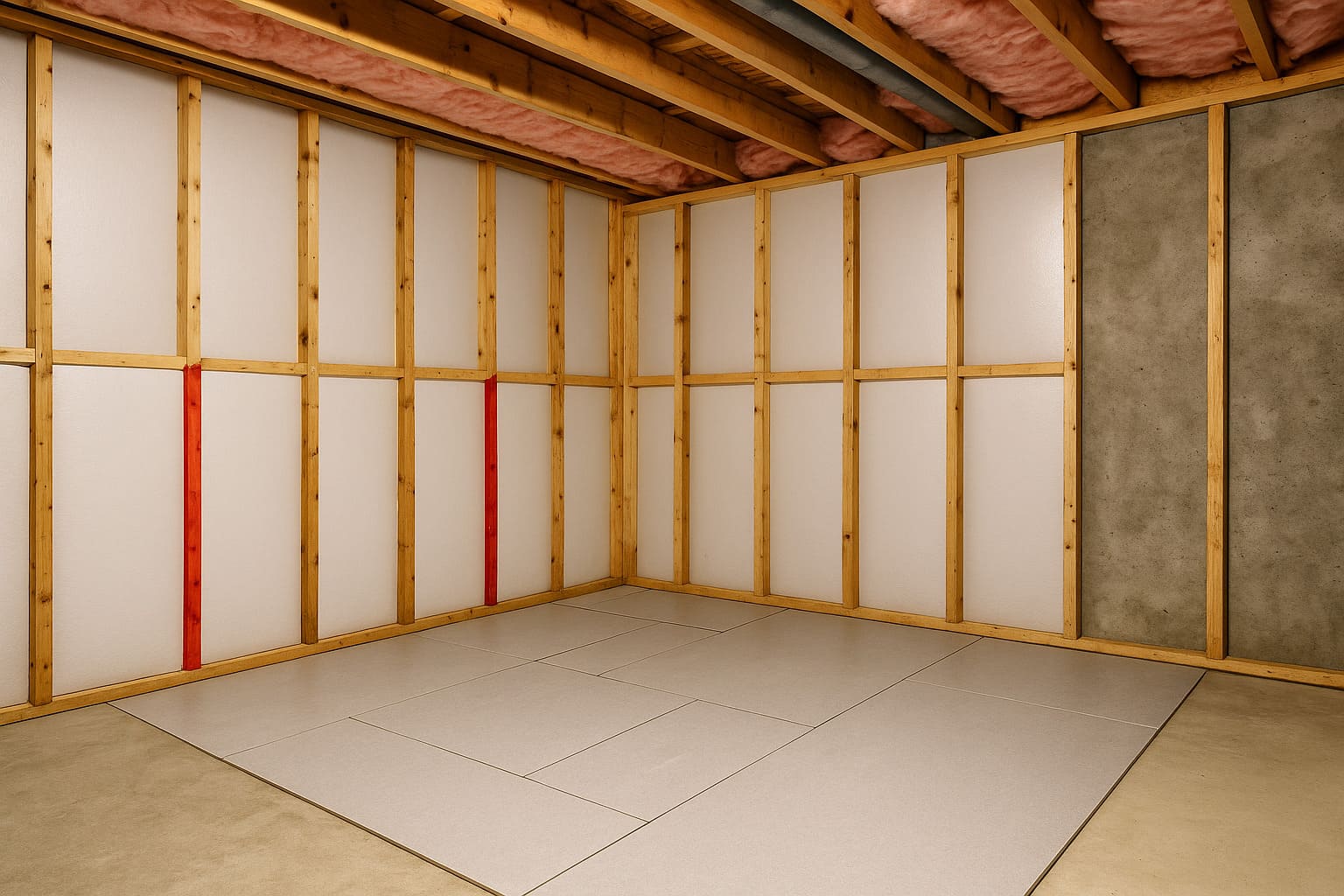
If you’re a homeowner in Edmonton thinking about how to make your home warmer, quieter, and more comfortable, this is for you. When we talk about basement insulation Edmonton, we’re not just talking about stuffing some foam under the floor or between joists. We’re talking strategic upgrades that cover insulating basement walls, treating the basement ceiling for sound, and insulating the basement floor, all in a climate that demands it.
In this article, you’ll learn:
- Why basement insulation matters in Edmonton’s climate
- How to insulate basement walls, the basement floor, and the basement ceiling (especially for sound)
- What to watch out for (moisture, permit issues, contractor expertise)
- How Steadfast Constructions Ltd can help you navigate the whole process
Let’s dive in.
Why basement insulation matters in Edmonton
Edmonton’s winters are long and cold; your home’s basement is part of the building envelope that can leak heat, let in drafts, or reflect cold floors upstairs. According to Natural Resources Canada, basement areas can account for about 25 % of a home’s total heat loss through uninsulated foundation walls and floors. natural-resources.canada.ca
When the basement is under-insulated, you’ll notice: colder surfaces, more uneven temperature upstairs, possibly higher energy bills, and even moisture or mould risks if not done right.
Why insulating basement walls is especially important
Insulating basement walls (rather than skipping them) is often one of the most effective moves. One study found that insulating the upper half of a basement wall can reduce heat loss by roughly half in cold-climate homes; full-height insulation can reduce it further. buildingscience.com
In short: If you live in Edmonton and have a basement, treating that space properly is an investment in comfort and home value, not a luxury.
How to insulate basement walls in Edmonton
Here’s a breakdown of what you need to think about when targeting insulating basement walls as part of your basement insulation Edmonton project.
Inspecting and preparing the space
Before you even pick material, make sure the basics are handled:
- Check for any moisture issues: water seepage, damp concrete, poor drainage. If you skip this, insulation could trap moisture and create mould. buildingscience.com
- Confirm vapour and air-barrier strategy: A basement’s wall assembly must handle thermal, moisture, and vapour flows reliably. The building science research warns that incorrect vapour barrier placement in basement insulation can cause serious issues. buildingscience.com
- Clean and inspect the foundation wall, ensure proper external drainage, grade away from the foundation, check any rim joist air leaks, etc.
Choosing the right insulation approach for basement wall insulation
When you’re thinking about basement wall insulation (again, key phrase), you’ll consider factors like material type, installation method, and compatibility with Edmonton conditions.
Common insulation methods
- Rigid foam board: Often used directly against the foundation wall. It’s moisture-tolerant and a good choice for basement walls in cold climates. buildingscience.com+1
- Spray foam: Especially closed-cell foam can act as insulation + air barrier, + moisture control. Good for tricky areas or tight assemblies. proinsulate.ca
- Fibreglass batts or other cavity insulation: Possible, but must be paired with a correct vapour/air control strategy and often not ideal in cold basement walls alone. Building science warns of mould/decay risk if insulation is installed improperly. buildingscience.com
Installation tips for durability and performance
- Seal joints and transitions carefully: For example, where basement walls meet rim joists, floors, and slabs.
- Consider full-height versus partial insulation: In many homes, insulating the whole basement wall (to grade) provides the best results for comfort and energy savings.
- Combine insulation with a vapour/air-barrier strategy: A layering detail that lets the wall assembly dry appropriately is key.
- Don’t forget finishing details: If you plan to finish the basement (for living space or rental), the insulation method must align with finishing plans, fire code, and moisture strategy.
- Choose a contractor familiar with Edmonton’s climate and building code requirements: Local expertise matters.
Benefits of insulating basement walls
- Warmer basement and upstairs spaces (because of less cold wall surfaces).
- Energy efficiency: Less heat is lost through the foundation.
- Better humidity and moisture control with the right assembly.
- Increased usable space: Once insulated correctly, the basement becomes a more comfortable environment for finishing.
- Improved resale value: A well-insulated basement is a stronger selling point (in the Edmonton market).
How to handle basement floor insulation
Beyond walls, basement floor insulation is part of a full basement insulation Edmonton strategy. If you’re going to convert your basement to living space (family room, guest room, home office), floor comfort matters.
Why floor insulation matters
Concrete slabs and basement floors are large, cold surfaces. They can transmit cold from the ground and make the space uncomfortable. Insulating the floor helps:
- Supports comfort: warmer underfoot, more even temperature.
- Protects finishes: carpet, laminate, or other flooring will perform better when the slab is closer to room temperature.
- Helps thermal control: minimizes heat transfer into the slab when you’re heating the basement or the rooms above.
How to insulate the basement floor
Here are some ways:
- Rigid foam board under a new slab or on top of an existing slab when designing a finished basement.
- Insulated sub-floor systems: Where space allows, build a wood or engineered sub-floor on top of insulation and a moisture barrier.
- Address edges and perimeter: Thermal bridging can happen at slab edges and rim joist conditions, so insulation highlighting these zones is beneficial.
- Moisture control: If the slab is old or there is a moisture risk, use a vapour barrier underneath insulation or sub-floor assembly.
Considerations for Edmonton homes
- Basement floor insulation works best when combined with appropriate wall insulation and proper moisture management.
- If you’re finishing the basement, your floor choice and insulation strategy should coordinate with the design (e.g., drop ceilings, partitions).
- A renovation contractor with local Edmonton experience understands how to integrate floor insulation with basement finishing projects.
How to insulate basement ceilings and address noise
If your basement is used for a recreation room, home theatre, or rental suite, basement ceiling noise insulation becomes a key concern. Sound travels downward and upward and can affect living spaces above or below.
Why soundproof insulation for the basement ceiling matters
- Reduces noise transmission from basement to main floor (and vice versa), good for home offices, guest rooms, or multi-use spaces.
- Helps create a comfortable acoustic environment: less echo, less footsteps impact, and less HVAC/duct noise transmitted.
- Increases the overall value and livability of the basement space.
Strategies for soundproof insulation of the basement ceiling
- Use acoustic insulation batts in ceiling cavities combined with resilient channels or isolation clips for better performance.
- Combine insulation with actual ceiling treatments: e.g., dropped gypsum board, acoustic panels, sealed joints.
- Consider sound-blocking materials combined with insulation (e.g., mass-loaded vinyl in certain designs).
- Address other noise paths: ductwork, plumbing, electrical penetrations, and open joists. Insulation alone won’t solve all noise issues; the assembly design matters.
What this means for your “basement insulation Edmonton” plan
In your full basement insulation upgrade, include ceiling sound treatment if you’ll use the space for entertainment, rental, or multi-generational use. Mention this to your contractor from the start — firms such as Steadfast Constructions Ltd include these details in broader basement finishing scopes (insulation, sound, code compliance, finishing) for Edmonton homes.
Choosing the right contractor for your basement insulation Edmonton project
It’s one thing to understand what needs to be done; it’s another to pick a trusted partner. Here’s what Edmonton homeowners should look for when hiring a pro.
What to check in a contractor
- Local experience: They know Edmonton’s climate, building code, and insulation best practices.
- Written scope of work: Including details for insulating basement walls, floors, and ceilings, and soundproofing if needed.
- Permits & code compliance: If the basement is being converted to a living space or rental, ceiling height, egress, and insulation values matter.
- Moisture management plan: Because insulation in basements is only as good as the foundation’s water control.
- References/recent projects: Locally completed basement upgrades.
- Good warranty and documentation: On both labour and materials.
Why choose Steadfast Constructions Ltd
At Steadfast Constructions Ltd., we specialise in basement finishing projects in Edmonton, and that means insulation is part of our standard workflow. We handle everything: inspection, moisture check, insulation strategy (walls, floors, ceilings), code compliance, finishing, and trade coordination. If you’re planning your basement insulation Edmonton upgrade, this full-service approach removes the guesswork.
Real-world example: A basement upgrade in Edmonton
Let’s walk through a hypothetical (but realistic) scenario that a homeowner in Edmonton experienced with a full basement insulation upgrade:
Background: A 1970s bungalow in Edmonton, the basement had cold walls, a slab floor with carpet, and exposed ceiling joists. The homeowner wanted a family room and a home office.
Process:
- Moisture inspection: The exterior grade was modified, sump-pump discharge verified, and interior rim-joist air leaks sealed.
- Wall insulation: Rigid foam board applied directly to concrete foundation walls, sealed joints, then framed the wall inside. Insulation batts added between studs.
- Floor insulation: A sub-floor was installed over the slab using high-density insulation board + moisture barrier, then finished with engineered wood.
- Ceiling sound treatment: Acoustic insulation batts added between joists, resilient channels installed, and drywall ceiling hung.
- Finishing: Drywall, paint, trim, lighting. Home office built, family room ready.
Result: The basement became a warm, comfortable, quiet living space. The homeowner noted less noise transmission upstairs, a more stable temperature, and better daily use of the space. The investment in the “basement insulation Edmonton” strategy paid off in terms of comfort and value.
Common mistakes and how to avoid them
When it comes to basement insulation, homeowners often make avoidable errors. If you’re considering your basement insulation Edmonton project, look out for these.
Mistakes to avoid
- Skipping moisture or drainage checks: Insulating walls without fixing water issues = risk of mould, rot, and insulation failure.
- Using the wrong insulation type or assembly: For example, installing interior insulation without proper vapour control can trap moisture. buildingscience.com
- Ignoring sound insulation if you’ll use the basement as a living space: Just insulating walls isn’t enough when noise travels.
- Finishing without addressing slab/floor insulation: You’ll still have cold floors or loss of comfort.
- Hiring a contractor who doesn’t specialise in basements or the Edmonton climate: Basements are tricky; local experience matters.
Key question checklist for your project
Here are some questions to ask your contractor:
- What insulation strategy are you using for the basement walls + floor, + ceiling?
- How are you managing moisture and vapour control?
- Will you handle sound insulation for the ceiling (if needed)?
- Do you handle permits and code compliance for basement finishing/insulation?
- Can you show recent local Edmonton basement projects?
- What warranty do you provide on materials and labour?
Bringing it all together: Your basement insulation Edmonton plan
Here’s a simple step-by-step to plan your basement insulation upgrade:
- Assessment & planning
- Inspect for moisture, drainage, and air leaks.
- Define use of basement (family room, home office, rental).
- Define insulation scope (walls, floor, ceiling/sound).
- Choose a contractor (local, experienced in Edmonton).
- Insulation execution
- Prepare walls, seal rim joists, and fix any moisture issues.
- Insulate basement walls with rigid foam/spray foam/batts as appropriate.
- Insulate the slab/floor if needed.
- Install ceiling insulation for sound if required.
- Finishing & quality control
- Finish drywall, flooring, trim, and lighting.
- Check final performance: comfort, sound, and even temperature.
- Ensure documentation, warranties, and permit close-out (if finishing to code).
- Enjoy your space
- A warmer, quieter, more usable basement.
- A home that functions better in Edmonton’s climate.
- Added value and better resale appeal.
Why now is a great time for basement insulation in Edmonton
- Energy efficiency is increasingly important in Canada; homeowners and buyers alike value properly insulated homes.
- Many older Edmonton homes were built without modern basement insulation standards, meaning there’s significant upside potential. Studies show considerable retrofit potential for basement walls in Canada. NAIMA Canada
- With the right contractor like Steadfast Constructions Ltd., you get a turnkey solution covering inspection, insulation, finishing, soundproofing, and code-compliance.
Conclusion
If you’re a homeowner in Edmonton looking to upgrade your home, investing in basement insulation Edmonton is a smart move. By focusing on insulating basement walls, adding basement floor insulation, and addressing basement ceiling noise insulation, you’re improving comfort, reducing energy loss, and creating usable space.
With local climate demands and the particularities of basement renovation, choosing a contractor who understands Edmonton conditions, moisture management, finishing, and sound insulation is key. That’s where Steadfast Constructions Ltd comes in: we handle the start-to-finish process, from assessment to full execution — so you don’t have to navigate the details alone.
Ready to move forward? Contact Steadfast Constructions Ltd today and let us tailor your basement insulation Edmonton project to your home’s needs, so you can enjoy a warmer, quieter, more comfortable basement space sooner.
Frequently Asked Questions (FAQs)
What are the signs that my basement needs better insulation in Edmonton?
If your basement walls are cold to the touch, the space upstairs feels colder than the rest of the house, you hear more noise from the basement, or the floor feels chilly, these are strong signs that you need better basement insulation in Edmonton.
Can I insulate my basement walls myself, or should I hire a pro in Edmonton?
While some insulation tasks might be DIY-friendly, basement insulation often involves moisture control, vapour/air-barrier strategy, floor and ceiling details, and possibly finishing work. Hiring a contractor experienced in Edmonton-area basements ensures the job is done right and avoids problems like mould or failed inspections.
Does basement insulation in Edmonton cover noise insulation for the ceiling as well
Yes, a full basement insulation Edmonton plan often includes treating the ceiling for sound (basement ceiling noise insulation). Especially if you’ll use the space as a living area or rental, ceiling sound treatment helps reduce noise transfer and improve comfort.
What materials are best for insulating basement walls in Edmonton?
Good materials for basement wall insulation include rigid foam board (moisture-tolerant), closed-cell spray foam (for air seal + moisture control), and insulation batts when installed correctly with a proper vapour/air barrier strategy. The best choice depends on your basement’s condition and finishing plan.
How does insulating my basement floor help with comfort in Edmonton homes?
Insulating the basement floor reduces cold surfaces, helps the floor feel warmer underfoot, limits heat loss via the slab, and supports the finished space above. For Edmonton homes, where winters are cold, this adds to overall comfort and livability.